
The drive doesn't change. Only the clock you read it on does. Every time in a road trip plan belongs to the place where it happens: leave Évora at 9:15 on Portuguese time, drive about an hour and forty minutes, and you reach Mérida at 11:54 on Spanish time. Same drive. The clock on the wall moved.
That's the whole rule, and it sounds too simple to get wrong. The trouble starts when a plan quietly mixes clocks: a departure written in one zone, an arrival worked out in another, a list of times that follows whichever zone your phone happens to be in. That's where the "lost hour" comes from, along with the dinner booking that turns out to be an hour closer than you thought.
Which clock is an arrival time on?
The clock of the place you're arriving in. Always.
The alternatives all sound reasonable, which is the problem. The time back home stops mattering the moment you leave. A plan that shows everything on your phone's current clock is right for where you're standing and wrong for anywhere across a border.
So: every departure on the clock of the town you're leaving, every arrival on the clock of the town you're arriving in, and the jump between the two happens once, at the border. It isn't spread across the day or tucked into the last arrival.
Which European borders change the clock?
Fewer than you'd think. From Spain to Poland, taking in France, the Benelux countries, Germany, Switzerland, Austria, Italy, Czechia, Denmark, Norway, Sweden and the western Balkans, continental Europe runs on one clock: Central European Time. You can drive from Seville to Warsaw without changing your watch.
The clock moves at the edges:
| Driving this way | Your clock |
|---|---|
| Portugal → Spain | forward 1 hour |
| UK or Ireland → France (ferry or tunnel) | forward 1 hour |
| Poland → Lithuania | forward 1 hour |
| Sweden or Norway → Finland | forward 1 hour |
| Hungary → Romania | forward 1 hour |
| Serbia or North Macedonia → Bulgaria | forward 1 hour |
| North Macedonia or Albania → Greece | forward 1 hour |
| Greece or Bulgaria → Turkey | no change in summer; forward 1 hour in winter |
Drive the other way and the clock goes back by the same amount. Mainland Portugal, the UK and Ireland sit an hour behind the middle of Europe; Finland, the Baltic states, Romania, Bulgaria and Greece sit an hour ahead.
The last row is the odd one out, for the reason the next section is about. Turkey doesn't put its clocks forward in spring or back in autumn, so the gap to its neighbours depends on the season. Everywhere else in the table, both sides change on the same night, so the difference holds all year.
What happens on a daylight-saving weekend?
Across the EU, and in the UK, Norway and Switzerland too, the clocks change on the last Sunday of March and the last Sunday of October, at the same moment everywhere, in the small hours of Sunday morning. The next change is Sunday 25 October 2026: at 3 a.m. in Central Europe the clocks go back to 2 a.m.
If you're on the road that weekend, three things are worth knowing:
- The night is 23 or 25 hours long. In October you get an extra hour; in March you lose one. A 9:00 start the next morning is still 9:00. It's the night that stretched or shrank.
- Anything counted in 24-hour blocks comes out an hour wrong. From 9:00 on a Friday to 9:00 on the Sunday is normally 48 hours. On the last weekend of March it's 47, and on the last weekend of October it's 49. Count nights on the calendar, not in hours.
- Booked times that Sunday are on the new clock. Read a ferry, a museum slot or a check-out time as local time after the change.
What doesn't change is the difference between two EU countries: both sides move together. The only way to meet the change mid-drive is to be driving in the middle of the night.
How do you read an arrival time across a border?
Four habits make it hard to get wrong:
- Write every time in local time. A departure goes on the clock where you leave and an arrival on the clock where you arrive. Don't convert "for convenience". That's how one plan ends up with two clocks in it.
- Put the jump in one place. The hour changes at the border, so that's where it goes in the plan.
- Keep the driving time honest. A border doesn't make the drive shorter or longer. Évora to Mérida is about an hour and forty minutes behind the wheel whatever the clocks say, so plan breaks and charging on the driving time, not on the gap between two clock readings.
- Mind the evening. Heading east you arrive an hour "later" and your evening is an hour shorter; heading west you get the hour back. A 20:00 table in Seville is 19:00 on the Portuguese clock you had at breakfast.
Does the same apply to a US road trip?
Yes, with one famous twist. The mainland US has four main time zones (Eastern, Central, Mountain and Pacific), and the clocks change on the second Sunday of March and the first Sunday of November, at 2 a.m. local time in each zone. In 2026 that's 8 March and 1 November.
The twist is Arizona, which stays on Mountain Standard Time all year. The exception inside the exception is the Navajo Nation in the state's northeast, Monument Valley included, which does change its clocks. So drive from Las Vegas to the Grand Canyon in July and your clock doesn't move. Do the same drive in December and it jumps forward an hour. And in summer, Monument Valley is an hour ahead of the Grand Canyon.
Where Fernweh fits
Since version 1.24, each stop you add to a trip in Fernweh stores the time zone of the place it's in, and every arrival and departure is shown on that stop's own clock, never your phone's. There's no second clock on any row: every time is the local one.
Where the clock changes between two stops, the itinerary says so in a row of its own, naming the zone you're entering and how far the clock jumps. The first one on a trip also gives your next arrival on both clocks. On this sample Lisbon-to-Seville trip it reads: "Mérida, Spain arrival 11:54 AM is 10:54 AM by the clock you left."
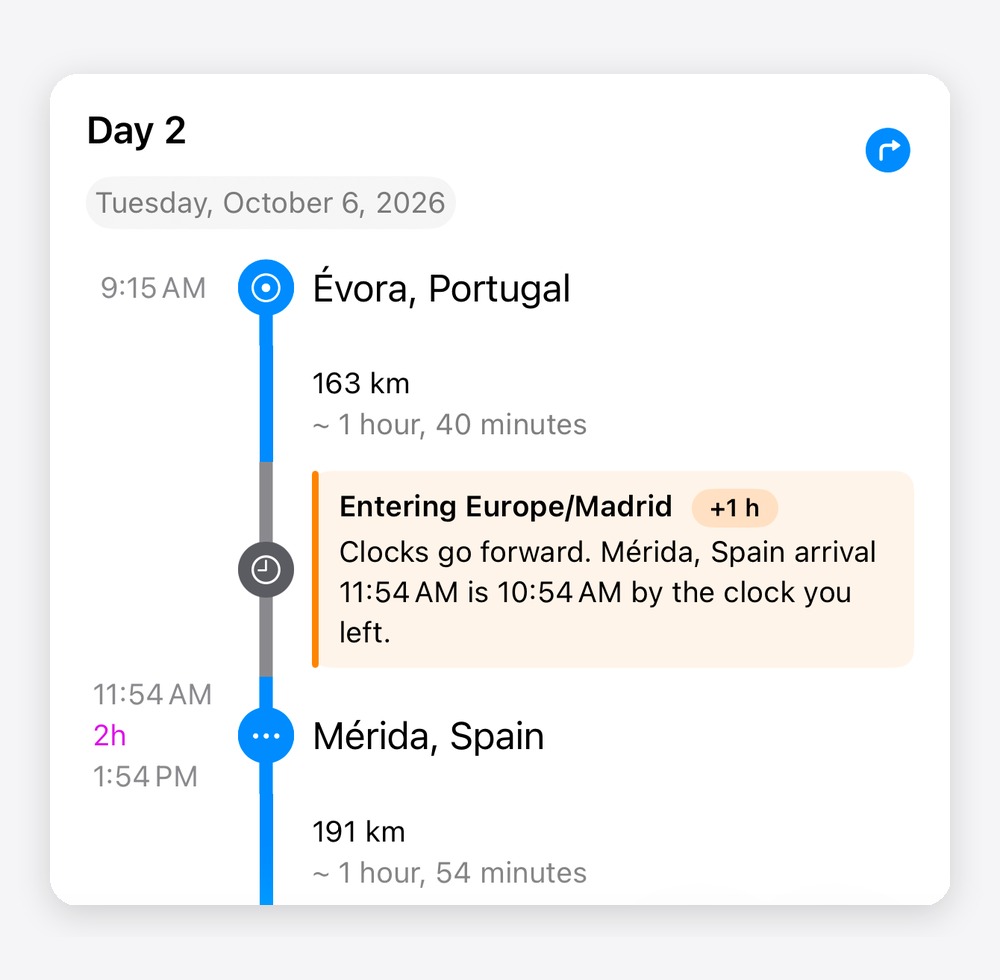
The row only appears when the clock actually changes at the moment you drive that leg, not when the map crosses a line. Munich to Salzburg crosses a border and gets no row. A December drive from Las Vegas to the Grand Canyon gets one, and the same drive in July doesn't.
The daily start time you set once in Settings, say 9:00, is read on the clock of the town you woke up in. The morning after the border, you leave at 9:00 Spanish time, not 9:00 Portuguese. A night across a clock change counts as the 23 or 25 hours it really is, and you still leave at 9:00.
Plan the trip at home and it reads the same on the road, whatever zone your phone has switched to. Two phones sharing the trip from different countries agree on every time in it. With calendar sync, which comes with Road Trip Pro, the event for a leg that crosses a border names the change and gives both clocks. A PDF export states the crossing too.
One honest limit: stops you added before version 1.24 don't know their time zone. They keep reading on your phone's clock, exactly as they always did.
An hour lost at a border should read as a fact about the map, not a mistake in your plan.
Quick answers
Is Portugal in a different time zone from Spain?
Yes. Mainland Portugal is one hour behind mainland Spain all year round. Driving from Portugal into Spain your clock goes forward an hour, and it goes back an hour on the way home.
When do the clocks change in Europe in 2026?
Sunday 29 March (forward one hour) and Sunday 25 October (back one hour). The change happens at the same moment across the EU, the UK, Norway and Switzerland.
Do you lose an hour driving east across a time zone?
On the clock, yes: you arrive an hour later than the drive took, and your evening is an hour shorter. The drive itself takes exactly as long as it would have.
Does Arizona change its clocks?
No. Arizona stays on Mountain Standard Time all year, except the Navajo Nation, which follows daylight saving time. So the difference between Arizona and its neighbours depends on the season.
Behaviour described here reflects Fernweh on iOS as of version 1.24.0, released 14 September 2026. Time zones and the 2026 clock-change dates come from the IANA time zone database (release 2026c). The screenshot shows a sample trip dated October 2026. Header photo by Dina Spencer on Unsplash.