
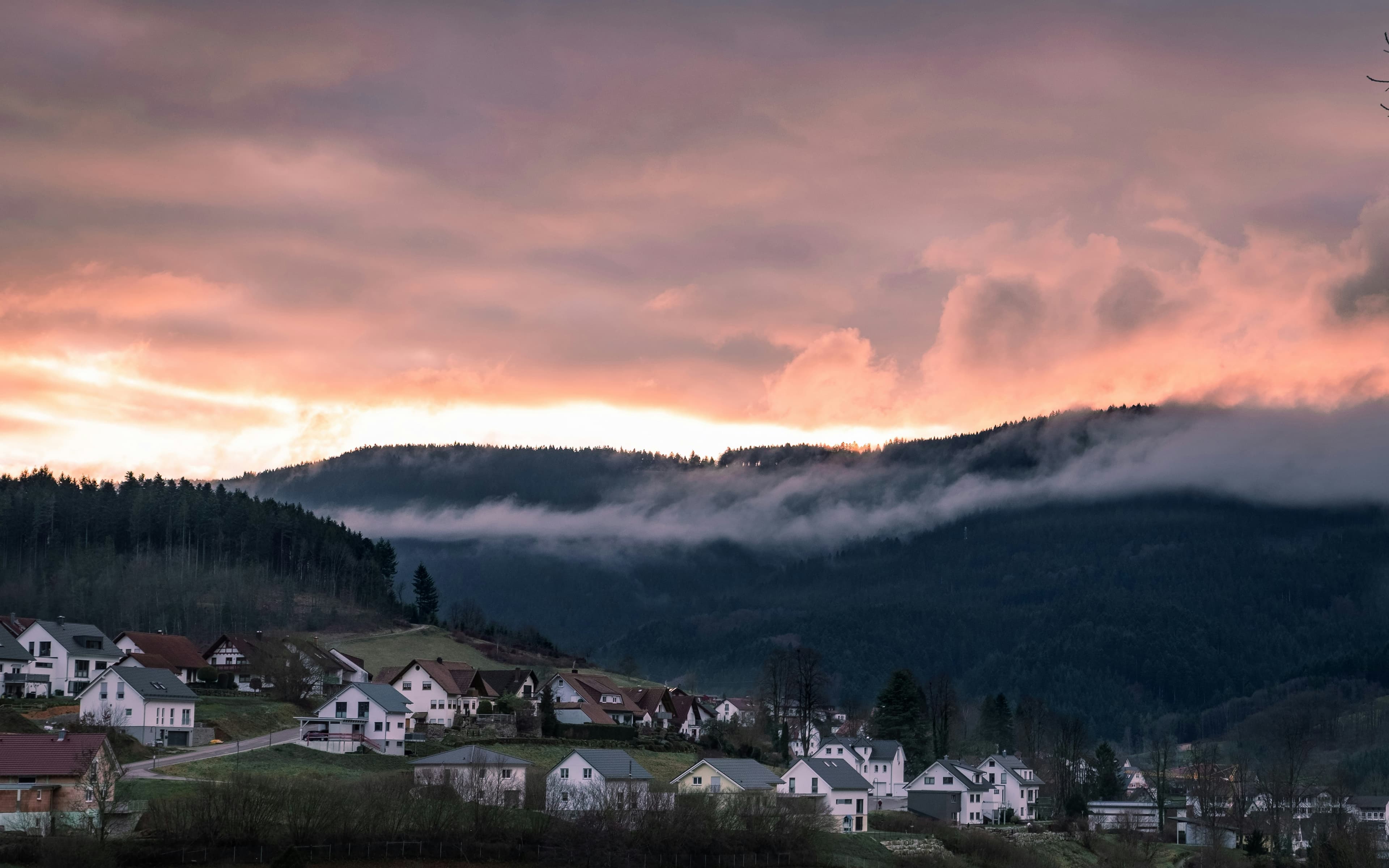
The Black Forest is sneakily good for an electric car. Distances between villages are short, hotels with overnight chargers cluster in the spa and tourism towns, and the B500 — the Schwarzwaldhochstraße that runs along the high ridge — turns the drive itself into the point of the trip rather than the bit you tolerate between stops.
This is the loop I'd suggest if you have four days and want a route that mixes spa towns, lake views, and the cuckoo-clock heartland without ever feeling stretched. It starts and ends in Stuttgart, runs about 500 km in total, and is built around three overnight stops with hotel charging — so the fast-charging stops are short ones, taken at moments when stopping was the point anyway.
Why the Black Forest rewards an EV
A few specifics that make this region work better than most:
- Short legs. Almost every interesting stretch is under 100 km. You're rarely choosing between charging now and risking it later — you're choosing where to take a coffee.
- Hotel-charger density. Baiersbronn alone has multiple hotels with on-site EV charging, including the three-Michelin-starred Hotel Traube Tonbach and Sackmann Genusshotel. The Hochschwarzwald (around Titisee) and Freiburg add more.
- A scenic spine. The B500 Schwarzwaldhochstraße gives you ~60 km of high-ridge scenery between Baden-Baden and Freudenstadt — long sightlines, smooth curves, panoramic views. The full B500 carries on south for another ~170 km toward the Swiss border if you want to extend.
- A dense fast-charge network where you actually need it. EnBW — the German utility whose home territory this is — operates 8,000+ fast-charging points in Germany, with an average density of one fast-charge location every 50 km. The corridors around the A8 and A81 also see IONITY ultra-fast sites.
If you've read our E-Grand Tour of Switzerland piece, the shape will feel familiar: hotel charging carries the trip, fast chargers cover the long legs, scenery sets the pace. The Black Forest is a tighter, more compact version of the same idea.
The 4-day loop, at a glance
A practical sketch you can adjust. The mileage is comfortable; the charging is generous; the towns are real ones with reasons to stop.
Day 1 — Stuttgart → Baden-Baden → Triberg → Freiburg (1 night) The long-driving day. Start with the A8 west to Baden-Baden for a spa-town pause, then pick up the B500 ridge south to Triberg — the cuckoo-clock heartland, with Germany's tallest waterfall a short walk from the centre. Stop for a fast charge here; coffee or Schwarzwälder Kirschtorte go well with a 30-minute top-up. Continue down via the B33 / B31 to Freiburg, where overnight chargers cover the rest.
Day 2 — Freiburg → Titisee → Hinterzarten (1 night) A short driving day on purpose. The B31 east into the Höllental ("Hell Valley" — sounds dramatic, mostly drives like a brisk countryside road) brings you to Lake Titisee: clear water, walking paths, boat rides. Continue 7 km on to Hinterzarten, a quieter Hochschwarzwald village with hotel charging, hiking trails out the door, and an Olympic ski-jump hill that doubles as a viewpoint in summer.
Day 3 — Hinterzarten → Schluchsee → Donaueschingen → Baiersbronn (1 night) A scenic transit day that ends at one of the region's hotel-charger hubs. The B500 south to Schluchsee runs alongside the largest lake in the Black Forest. From there, east via the B31 to Donaueschingen — the official source of the Danube, signposted from a park you can walk to in five minutes — for a midday fast charge. The afternoon takes you back north via the B27 to Baiersbronn, a tourism-and-Michelin town in the northern Black Forest with several hotels offering EV charging for guests.
Day 4 — Baiersbronn → Tübingen → Stuttgart The "back to the airport" day done well. The B28 east drops you out of the Black Forest hills toward Tübingen, a university town on the Neckar with a cobbled old town worth a one-hour wander and one more fast-charge top-up if you need it. Then 45 km north back to Stuttgart on the B27.
Total: about 500 km over four days. Three overnights with hotel charging. Two intentional fast-charge stops. A real B500 drive.
You can download the route as a GPX file and import it into Fernweh or your planner of choice — the GPX carries all ten stops in order, with the three EV chargers flagged.
Charging realities — pass-through vs overnight
The mental model that makes Black Forest EV trips relaxing rather than fiddly:
Pass-through (fast charging during the day.) Two stops on this itinerary: Triberg on Day 1 (between Baden-Baden and Freiburg) and Donaueschingen on Day 3 (between Schluchsee and Baiersbronn). Both line up with natural lunch / coffee / sightseeing breaks. Treat them as the reason you're stopping anyway — not as something you're enduring because the battery says so.
The B500 corridor is well-covered by EnBW HyperCharger locations; the parallel A8 / A81 motorways add IONITY ultra-fast sites where they run near the region. Either app gives you live availability; cross-checking before you set off saves the "is this station actually working?" question on arrival.
Overnight (destination charging.) Three nights, three hotel chargers. Freiburg has dense options across most of the city's hotels; Hinterzarten and Baiersbronn both have several hotels in the Travelmyth EV-charging directory including Hotel Traube Tonbach and Sackmann Genusshotel. Book confirming the charger spec before you go — "EV charging on-site" can mean a Type 2 wall box (slow but fine for an overnight) or a destination DC unit; the difference matters if you arrive low.
The convenient effect: every morning of this trip starts with a full battery and no detour to make. By Day 4 the fast-charge stops have done so little work that the question "did we have enough?" never comes up.
Practical tips
Season. May through October is the comfortable window — the B500 is in good shape, the spa-town terraces are open, the lake at Titisee is swimmable in late summer. October brings spectacular forest colour; from November the ridge can carry snow.
No vignette needed (here). Germany doesn't require an autobahn vignette like Austria or Switzerland do. If you're extending the trip across the southern border into Switzerland, you'll need the Swiss vignette — but for the Black Forest portion, you just drive.
Altitude and range. The B500 climbs to around 1,000 m at its high points. EVs handle altitude well — the thinner air actually helps aerodynamically — but the climb itself does use more energy than the flats. The good news: the descent gives much (not all) of it back through regenerative braking, so net trip consumption on a ridge route isn't dramatically higher than on the motorway equivalent. In winter you'd add a 20–30% cold-weather range hit on top, which is why the May–October window is the relaxed one to do this loop.
Map traffic. The B500 is the most-scenic-road-in-Baden-Württemberg crowd's favourite drive on summer weekends. Weekday morning runs are the calmest; if you can't avoid a Saturday, an early start beats an afternoon one.
Where Fernweh fits
We built Fernweh to make trips like this one feel small instead of project-managed. Most of the work in planning a multi-stop EV trip isn't picking the destinations — it's keeping the schedule, the charging, the hotel chargers, and the calendar all in sync as you adjust. Fernweh tries to make that almost invisible.
A few things you'll notice on this trip in particular:
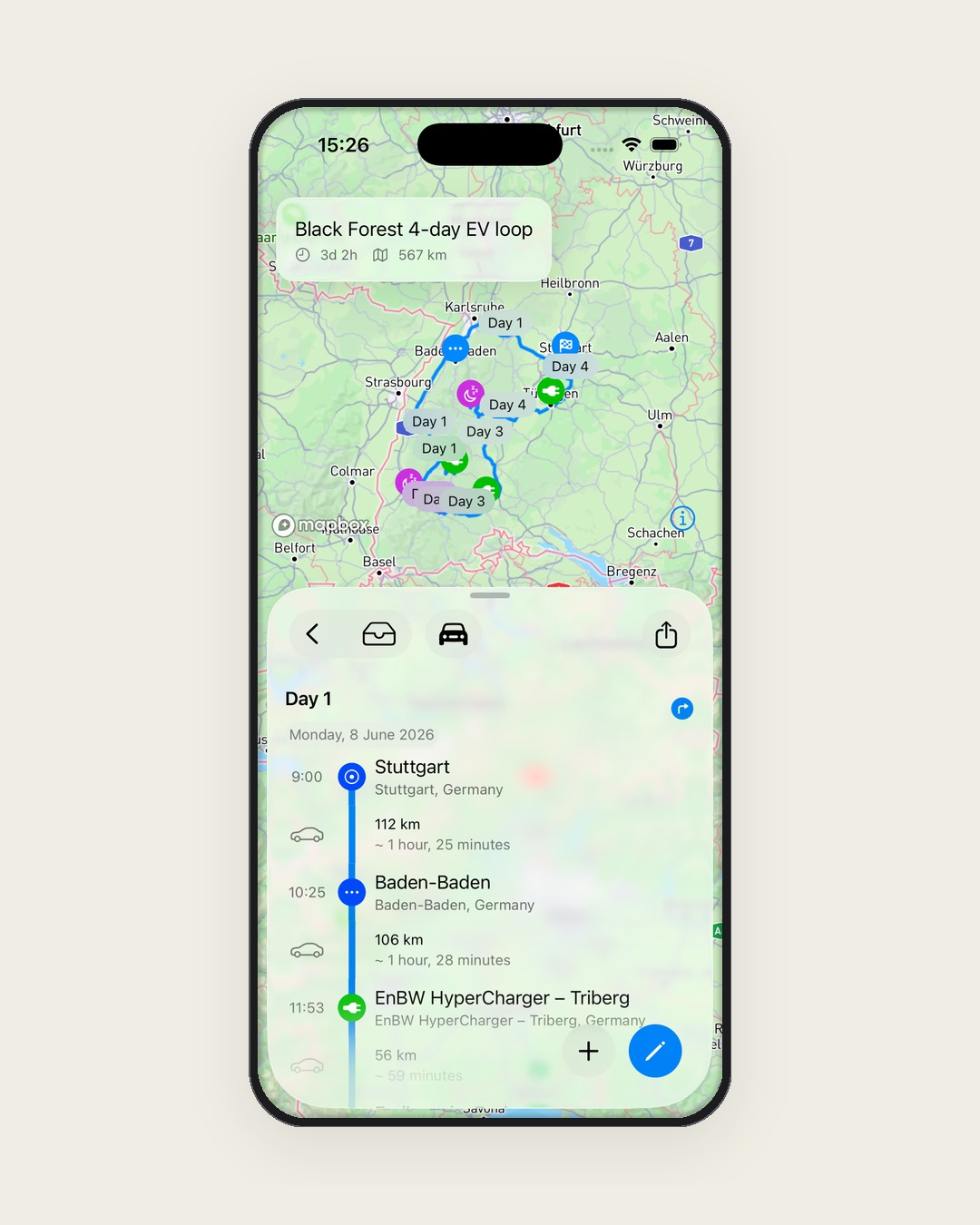
- Per-leg distances and times show up under each stop as soon as you build the itinerary, so you know whether Day 3 actually fits before you book the hotel.
- EV charging stops are first-class stops, the same shape as any other stop on the trip — the route line goes through them, the timing accounts for the dwell, and they render with their own green charger pin on both the map and the stop list. The three chargers on this loop (EnBW HyperCharger Triberg, Allego Donaueschingen, IONITY Tübingen) appear that way out of the box.
- Calendar sync writes the drive segments to Apple Calendar automatically — one event per leg, updated whenever you change the trip. So the rest of the week's schedule stays honest about when you'll actually be home.
The screenshot below is the same trip rendered in the app; you can see the loop drawn on the map, the per-leg distance + time figures, and the charger marked on the stop list.
For the planning-methodology side of things, our piece on three approaches to multi-stop road trip planning sketches when the "trip as one object" framing actually buys you something — and when a notes-page is still fine. And if you're weighing apps, the best EV road trip planners of 2026 round-up sets Fernweh against ABRP, Roadtrippers, Wanderlog, Furkot, and Google My Maps honestly.
Shortening or extending the loop
The 4-day shape above is what the GPX delivers. Two natural variations:
- Shorten to a long weekend (2 days) by skipping Titisee, Hinterzarten, and Baiersbronn — you go Stuttgart → Baden-Baden → Triberg → Freiburg → Schluchsee → Donaueschingen → Tübingen → Stuttgart. Same B500 backbone, less time in the Hochschwarzwald.
- Extend south into Switzerland (5–6 days) by continuing past Donaueschingen toward Schaffhausen and the Rhine Falls, then picking up the E-Grand Tour route. The Swiss vignette + cross-border charging arrangements are documented in that piece.
Both work as fixed itineraries or as openings for the kind of unstructured day that road trips do best — "we noticed a sign for a lake on the way and stopped for two hours."
A pre-trip checklist
A few things worth doing the day before:
- Install the EnBW mobility+ app and add a payment method while you have signal at home — registration SMS sometimes have trouble with foreign numbers.
- Confirm with your overnight hotels that the charger is available the night you're booked (the Black Forest gets busy enough that a hotel's two chargers can both be in use).
- If you're crossing into Switzerland to extend the trip south, buy the Swiss vignette online before you go.
- Throw a Type 2 cable in the car — most hotel chargers in Germany are CCS / Type 2 combos; some are Type 2 only.
That's the trip. Four days, three hotel chargers, two fast-charge stops, one scenic ridge, and the Black Forest in the kind of shape it actually rewards.
If you want the planning-side of this trip to feel even smaller than the loop itself, Fernweh handles the per-leg timing, the charging stops, and the calendar sync so the road can stay the part you're actually thinking about.