
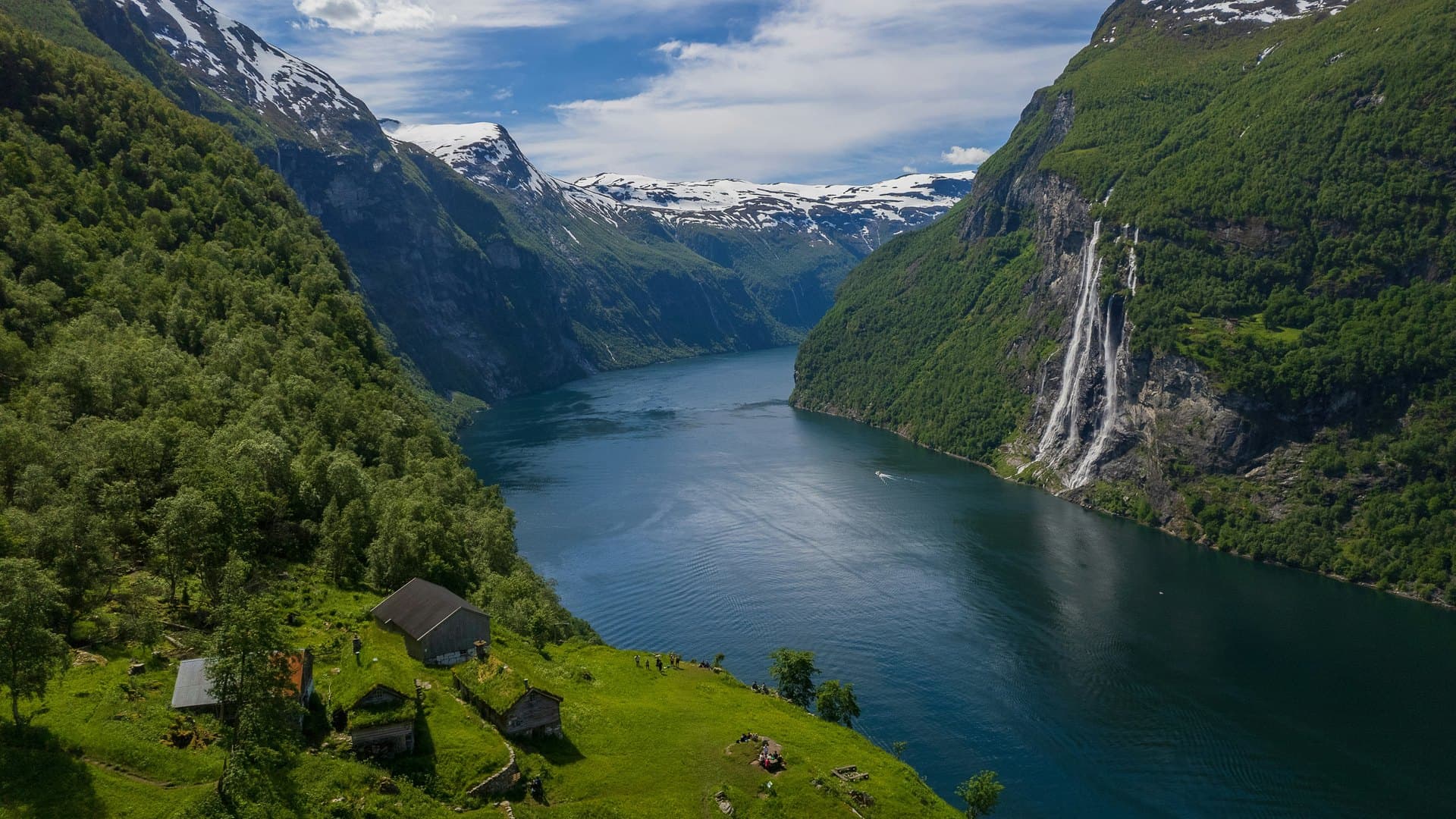
Norway is the easiest country in Europe to drive an EV through and one of the harder ones to schedule. Those two facts are not in tension — they are the whole planning problem. Charging is genuinely solved here. What is not solved is the arithmetic of a fjord: the road goes around, the ferry goes across, and the two options differ by an hour and a half that no one tells you about until you are standing at the quay.
This is a seven-day route from Bergen to Ålesund, and a set of notes about the parts that actually take planning.
How long do you need for a Norwegian fjord road trip?
Seven days, if you want to drive the three set-pieces — the Nærøyfjord stretch, Trollstigen, and the Atlantic Road — without spending the whole week behind the wheel.
The route below is about 925 km. That sounds like nothing spread over a week, and it is: the longest driving day is 150 km. Norwegian fjord roads run at perhaps 60 km/h once you account for tunnels, single-track sections, and the fact that you will stop for a waterfall whether or not you planned to. A 150 km day is a comfortable half-day of driving and an afternoon of being somewhere.
Five days forces you to skip either Geiranger or the Atlantic Road. Ten days lets you add Lofoten, which is a different trip.
The route, day by day
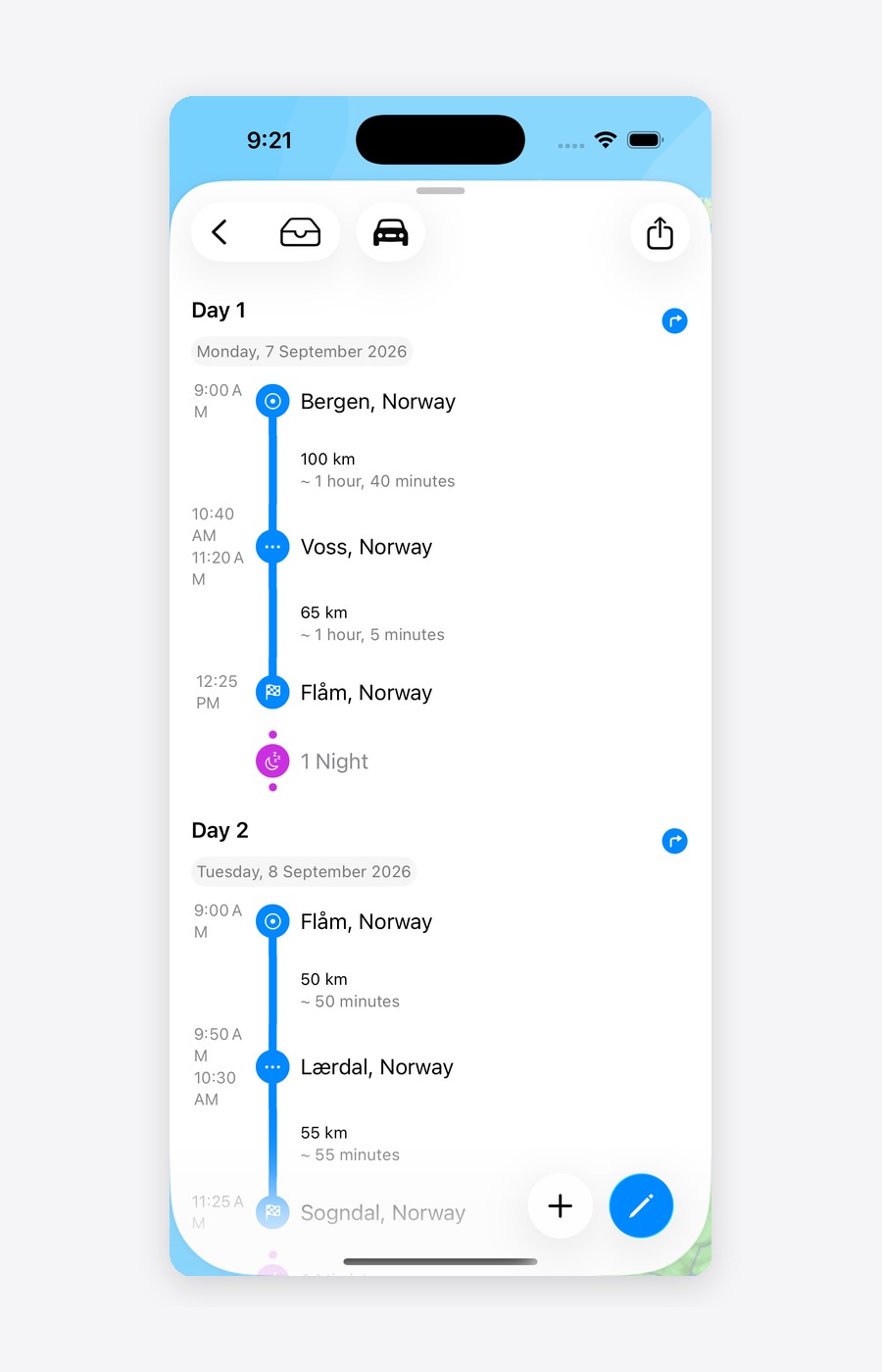
Day 1 — Bergen → Voss → Flåm, 165 km. East on the E16. Voss is the natural coffee stop; the stretch beyond it, down through Stalheim and Gudvangen, is the one people photograph. Overnight in Flåm.
Day 2 — Flåm → Lærdal → Sogndal, 105 km. Short and strange: the Lærdal tunnel is 24.5 km of mountain with mood-lit caverns cut into the middle of it. Then out along the Sognefjord to Sogndal.
Day 3 — Sogndal → Stryn, 150 km. The transitional day, north over to Nordfjord. Least dramatic on paper, and the one where you will actually relax.
Day 4 — Stryn → Geiranger, 120 km. Up over Videseter and Grotli, then the descent into Geiranger, which is the view that sells Norway to people who have never been.
Day 5 — Geiranger → Åndalsnes, 105 km. Ørnevegen north out of the fjord, then Trollstigen — eleven hairpins against a cliff. The shortest day of the week and the one that takes longest.
Day 6 — Åndalsnes → Kristiansund, 130 km. Out to the coast for the Atlantic Road, which is eight bridges strung across open water and worth the detour in bad weather more than good.
Day 7 — Kristiansund → Ålesund, 150 km. Back down the coast to finish somewhere with an airport and good seafood.
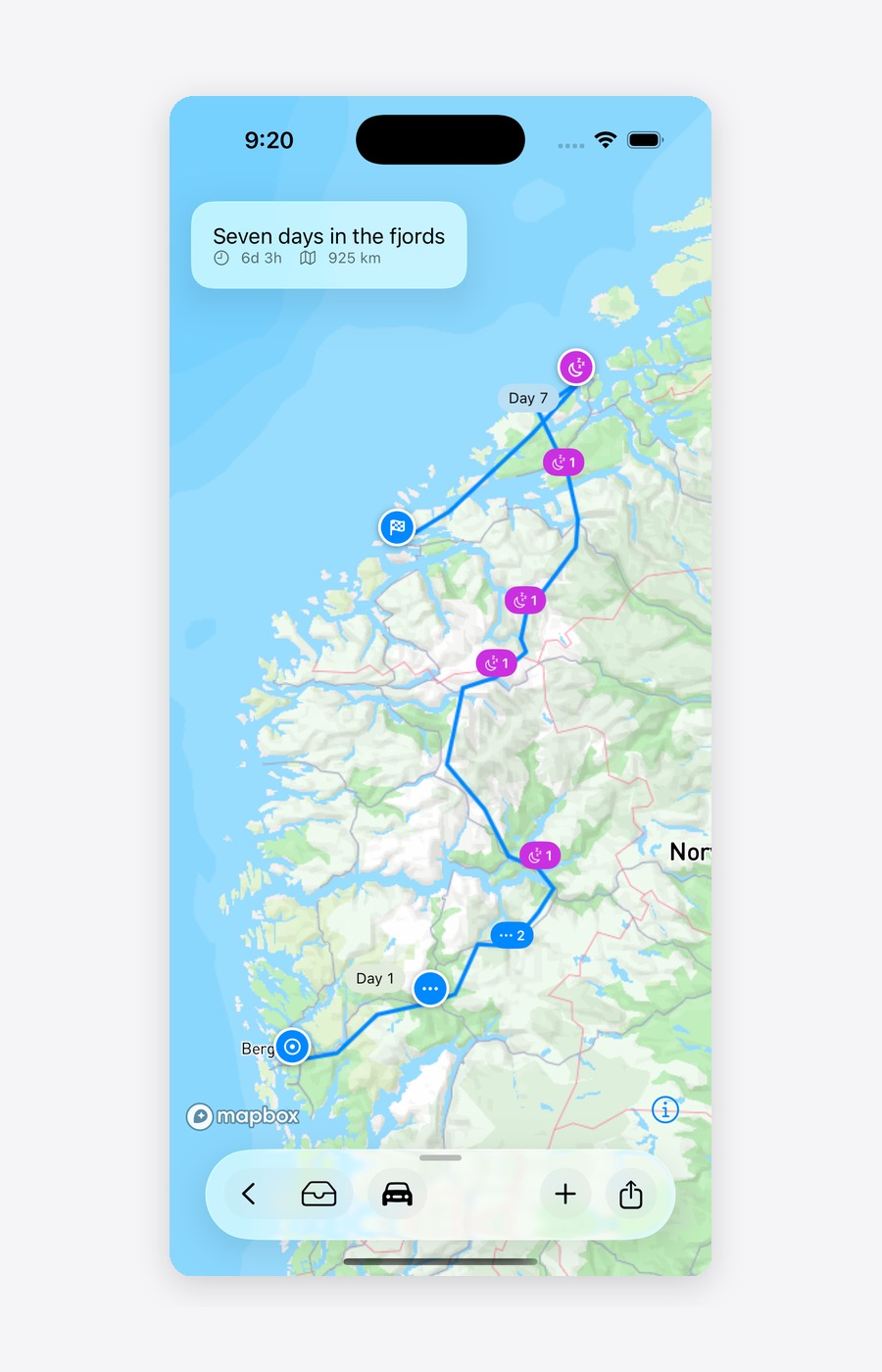
Want the route? Download the GPX — ten waypoints and the full track, importable into Fernweh or any GPX-aware app, so you can adjust it rather than retype it.
Do you need to worry about charging in Norway?
Less than almost anywhere. Norway has 9,478 fast chargers, and the network reaches well past the tourist corridors — even the far north, where there are more reindeer than people, is comfortably drivable on electricity. In 2024, 88.9% of new cars sold in Norway were EVs. The infrastructure is built for locals, not for visitors, which is exactly why it is good.
Two practical caveats that catch visitors out:
Register with the operators before you leave. Norway has around ten major charging providers, and sorting out an account at the charger, on foreign roaming data, in the rain, is a miserable way to spend twenty minutes. Do it at home. The map at ladestasjoner.no shows what is where.
Charge on the day's rhythm, not on range anxiety. The stops on this route are 105–165 km apart. Any modern EV does a day's leg on one charge, which means you are choosing when to charge for convenience rather than whether you can make it. Charge while you eat, at the place you were stopping anyway.
What about the ferries?
This is the part that breaks schedules, and it is worth being blunt about it.
Fjord country runs on ferries. A crossing is typically 15–25 minutes, but the number that matters is the wait, and the wait depends on the departure interval and how many cars are ahead of you. In high summer, on a popular crossing, missing a sailing can cost you an hour. EVs get discounted ferry tickets in Norway, which is pleasant but does not make the boat leave sooner.
The honest planning advice: look up the timetable for any crossing on your route, and add the wait to your day yourself. Fernweh flags where a route crosses water rather than driving around it — on the Pro map that is an explicit ferry glyph and a dotted line in place of the road polyline; on the free tier it comes through as advisory text in the directions. Either way you can see the crossing is there. If you have booked a sailing, add the ferry terminal as a stop and pin your arrival there: Fernweh paces the day towards it and tells you if the drive can't make it. It does not read timetables or predict the queue, so the times — and the buffer — still come from you.
The route above deliberately favours roads and tunnels over crossings for exactly this reason. You can shave time off several of these days by taking a ferry instead of driving around a fjord — just do it knowingly.
Here is the arithmetic, because it is the thing people get wrong. Say a crossing saves you 50 km of driving around a fjord. At fjord-road speeds that is roughly 50 minutes of driving you avoid. The crossing itself is 20 minutes. That looks like a clear 30-minute win, and on a quiet Tuesday in April it is.
Now add the parts that do not appear on a map. The sailing runs every 40 minutes, so on average you wait 20 for a boat, and if you arrive badly you wait 40. In July, at a crossing that tour buses also use, one sailing can fill before you reach the front, which puts you on the next one. Your 30-minute saving is now somewhere between a 10-minute saving and a 30-minute loss, and you cannot know which until you are in the queue.
The point is not that ferries are bad — they are frequently the better road, and some of them are the most memorable half-hour of the day. The point is that a ferry is the one leg of a Norwegian trip whose duration you cannot compute in advance, so it is the one leg you should look up rather than estimate. Check the operator's timetable, note the interval, and give yourself the interval as buffer. On a seven-day route with two or three crossings, that habit is the difference between arriving for dinner and arriving for what is left of it.
How do you keep a seven-day plan from drifting?
The failure mode on a week-long trip is not getting lost. It is that day three runs forty minutes late, and days four through seven quietly inherit it, and you find out when a hotel calls to ask if you are still coming.
A few things that help, whether or not you use an app for it:
Pin the arrivals that are real. Most stops on a trip like this are soft — you get there when you get there. But a hotel check-in cut-off or a booked fjord cruise is a hard time. If you know you must be in Geiranger by 19:00, plan the day backwards from that, not forwards from breakfast. Fernweh does this now: give a stop an arrival time and the overnight stop before it departs at the hour that actually makes the arrival work, instead of leaving at your usual start time and reporting the mismatch back to you afterwards.
Decide your start time once. A week of days that each begin "around nine, probably" is a week that drifts. One daily start time, applied to every unpinned departure, turns a vague plan into a schedule you can check against.
Keep the bookings with the stops. Seven nights is seven confirmation numbers, seven prices, seven check-in times, and they are scattered across your inbox exactly when you need them. Any stop in Fernweh can now carry a price, a booking link, a confirmation reference and the operator name — so the hotel details live on the hotel, not in a search of your mail.
Let the stays be honest. A 45-minute lunch and a two-night base are both "stops", and pretending they are the same thing is what makes trip timelines lie. A stay can be a duration or a number of nights, whichever is true.
None of this is exotic. It is the difference between a plan that survives contact with a week of driving and one that becomes a list of places you meant to be.
Worth knowing before you go
- Weather decides more than you do. Trollstigen and the Geiranger mountain roads are seasonal — typically open late May to October, and closed by snow outside that. Check before committing to a date.
- Tolls are automatic and unavoidable. Register your plate with an AutoPASS-compatible provider; EVs pay reduced rates.
- The set-pieces reward bad weather. Geiranger in low cloud and the Atlantic Road in a swell are better than either in flat sunshine. Do not reschedule around a grey forecast.
Seven days, 925 km, six nights, three roads you will remember. The driving is the easy part — Norway has done the hard work on charging. Spend your planning time on the ferries and the arrival times, and the rest of it takes care of itself.
Corrected 2026-09-23: the ferry section first said Fernweh could not yet schedule a crossing as its own block. That was already out of date when this post went up: ferry crossings shipped in version 1.22 on 7 August 2026. The section now says how they work.
Corrected 2026-10-15: version 1.25 removed the ferry crossing editor this section described. Former ferry terminals are ordinary stops now, and the map still draws a detected crossing as a dotted line. The section now says what to do instead.